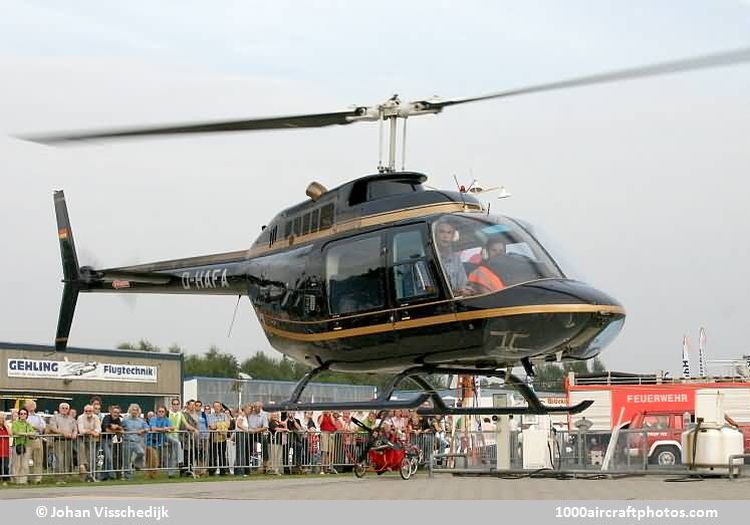
10/16/2003. Remarks by Johan Visschedijk: "Bell designed the Model 206 to compete in the 1961 US Army LOH-program (light observation helicopter). First (N73999) of five prototypes flew December 8, 1962 and bearing the military designation OH-4A, it was tested against the Fairchild Hiller FH-1100 OH-5A and the Hughes 369 OH-6A, the latter winning the contest.
Bell developed the OH-4A into a five-seat commercial model and named 206A JetRanger, it (N8590F) flew on January 10, 1966 and deliveries started January 1967. In 1968 it was entered the re-opened LOH contest as the OH-58A and was so successful that a contract for 2200 under the name Kiowa was issued. Refined and improved models followed and license production was undertaken by Agusta in Italy.
The next significant model came in 1974 with the seven-seat 206L LongRanger, having the fuselage lengthened by 2 ft 1 in (0.64 m), 1 ft 10 in (0.56 m) longer rotor blades, an uprated engine, and other improvements. First flown on September 11, 1974, deliveries began inOctober 1975, and an armed and armored military variant was introduced under the name TexasRanger. Again refined and improved models followed and the LongRanger was also built by Agusta in license.
During March 1978 the US Army started the upgrading of many of their OH-58As to the OH-58C version with stronger engines, new night-vision equipment, IR-protection and improved instruments and electronics. Further progress was made when Bell won the Army Helicopter Improvement Program (AHIP) in 1981, incorporating: even stronger engines, a stronger power-train, four-bladed rotor of new and composite construction, a Mast Mounted Sight (MMS) and many other observation-, protection- and attack equipment additions and improvements. The MMS containing a TV-camera, IR-sensors and a laser target designation system, gives the helicopter crew a possibility to look over the tree-tops, track and designate targets while staying out of sight. The first of five OH-58D prototypes flew October 6, 1983.
The for export intended 406CS Combat Scout flew in June 1985 and was a simplified 406 AHIP derivative without the MMS and with a quick-change weapons system.
The US Army ordered the 206B-3 as a pilot trainer under the designation TH-67A Creek, the prototype as YTH-67, all flying with civil registrations.
In 1984 a highly redesigned twin-engined version of the LongRanger was introduced, the 400 TwinRanger. First prototype (N3185K) flew on July 4, 1984 in the US, the production was to take place in a new Bell facility at Maribel, Quebec. The 400 did not proceed, but a development of the LongRanger became the 407, a concept demonstrator (modified 206L-4) flew April 21, 1994, followed by the first of two prototypes on June 1, 1995, deliveries from the Canadian facility commenced late 1995. By late 2002 over 6600 of all types had been delivered."