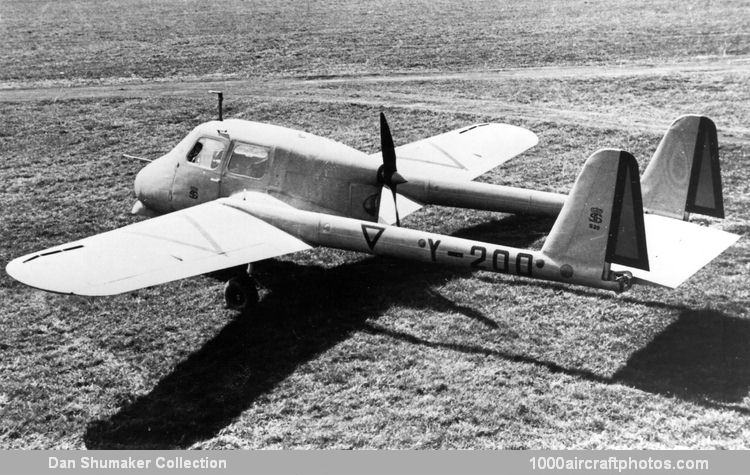
The aircraft could be used as a training aircraft for pilots who would in the future fly nose-wheel landing gear types, such as the Fokker D.XXIII and the Douglas DC-4. It could also be used as a sport aircraft and as an air taxi. There was therefore a reasonably good chance that the S.20 would have a bright future.
The prototype made its first flight on March 29, 1940, and featured a full military livery and carried the manufacturers test marking Y-200, equivalent to the British 'Class B' marking. Three letters were assigned: 'X' to Fokker, 'Y' to Pander (later De Schelde) and 'Z' to Koolhoven. Although the civil registration PH-ATY had been assigned on August 17, 1939, it was never applied. The aircraft was piloted on its first flight by J.T.H. Reintjes, who had recently joined De Schelde as a test pilot.
When the Netherlands entered WW II on May 10, 1940, no orders for the S.20 had yet been received because the test flight program had only just begun. The S.20 had not been damaged by the war, but because all flying activities on the Dutch side were prohibited after May 14, the aircraft was stored away until further notice. Together with the S.21 fighter under construction, the S.20 was suspended from an attic in one of the factory buildings of De Schelde.
After the company came under German control, the Germans initially paid little attention to it. However, after Fokker test pilot Hidde Leegstra and chief P.J.C. Vos had fled in a Fokker G.1 to England on May 5, 1941, the Luftwaffe launched a search throughout the Netherlands for hidden aircraft; the sole S.20, and the partly constructed S.21, were transferred to the Luftwaffe Zerlegebetreib (dismantling plant) in Utrecht. There they were subjected to maximum load tests, during which both broke into pieces. The S.20 Certificate of Registration expired August 17, 1942.
Span: 37 ft 2 in (11,35 m)
Length: 28 ft 4.5 in (8,65 m)
Height: 8 ft 6.33 in (2,60 m)
Wing area: 195.9 sq.ft (18,20 sq.m)
Fuel: 41.21 gal (156 l)
Empty weight: 1,984 lb (900 kg)
Loaded weight: 2,756 lb (1 250 kg)
Max speed: 149 mph (240 kmh)
Cruise speed: 124 mph (200 kmh)
Service ceiling: 16,405 ft (5,000 m)