07/20/2026. Remarks by
Johan Visschedijk: "In early 1931 the Board of Directors decided to end production due to the economic crash. Although the Cessna Aircraft Company at Wichita, Kansas, never went bankrupt, it did not produce any aircraft during 1931, 1932 and 1933. The buildings were rented out to provide income and keep the company solvent until economic conditions would permit the resumption of manufacturing activities.
Clyde Vernon Cessna and his son Eldon set up a shop at 3401 South Oliver, just one mile away from the then closed Cessna plant. Under the name of the C. V. Cessna Aircraft Co., Clyde and Eldon built four custom-designed aircraft during 1931, 1932, and 1933.
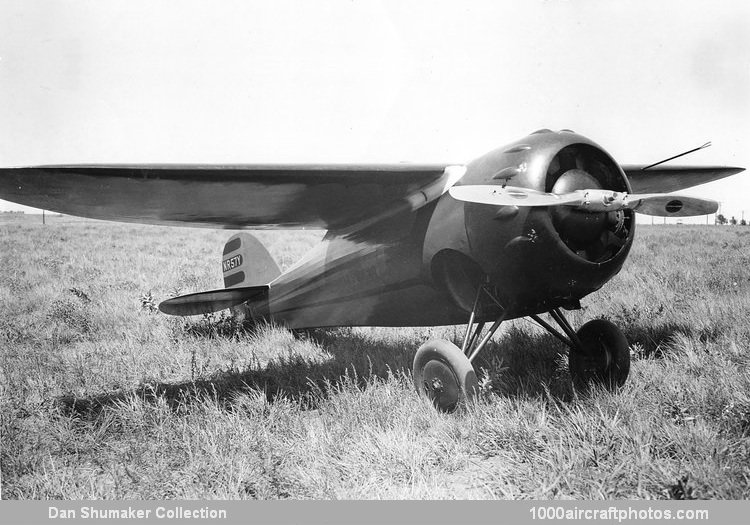
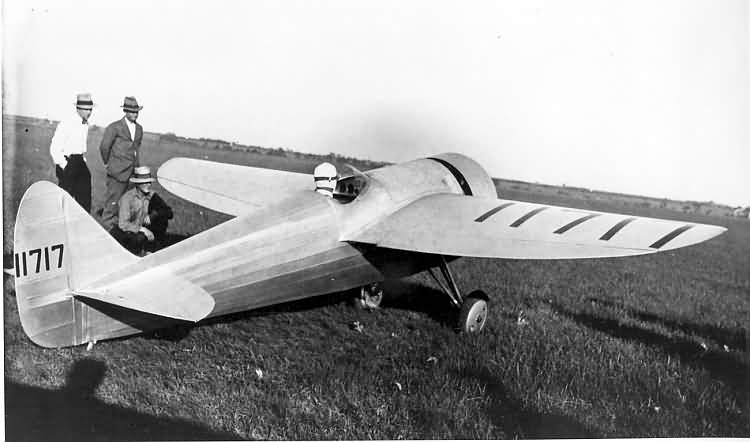
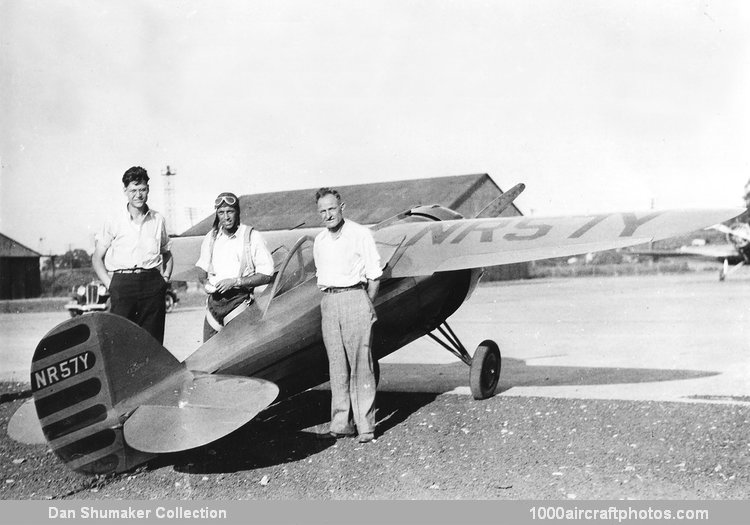
The first racer to be built by this pair at their South Oliver location was the CR-1 racer in 1932. This was a bullet shaped stubby racer, sporting a length of 14.5 ft (4.42 m) and a full cantilever wing of 18.5 ft (5.64 m). It was powered by a 125 hp Warner engine 422 cu.in (6.92 l) and incorporated a new retractable landing gear. The retractable landing gear raised up and in until it fitted snugly into wheel wells in the belly of the fuselage. It was raised and lowered by a large handle located on the instrument panel. This was Cessna's first attempt at retracting a landing gear.
The CR-1 was listed as 11717 (c/n 1) to C.V. Cessna and it was named "Miss Wanda" in honor of Clyde's sister. Beside assisting designing and building the aircraft, Eldon performed the test flights as well. In 1932, the noted racing pilot Roy Liggett streaked into Cleveland, Ohio, with the CR-1 for the National Air Races, August 27 to September 5. It proved to be very nimble and Liggett placed second in the 510 cu.in (8.36 l) event, third in 800 cu.in (13.11 l) event, and third in the Cleveland-Cincinnati-Cleveland Race. Liggett's best pylon speed with the CR-1 was 176.519 mph (284.080 kmh).
Johnny Livingston in center
As stated before, Johnny Livingston ordered a new special racer from Cessna after the 1933 Miami Air Races. The Cessna CR-3 was the fastest and most famous racer built by Cessna, it made its first test flight on June 11, 1933.
At Livingston's request, the wing was raised to a shoulder position, and the 145 hp Warner (499 cu.in, 8.18 l) engine was chosen as the power plant. A tight fitting NACA cowling, equipped with teardrop fairings to allow clearance for rocker box covers, shrouded the engine. A bubble canopy enclosed the cockpit. The CR-3 was 17 ft (5.18 m) long, had a wing span of 18.5 ft (5.64 m), and was 4.5 ft (1.37 m) high. Its empty weighed was 750 lb (340 kg).
Between June 11 and the big air races at Chicago, Livingston and the CR-3 raced at Omaha and Minneapolis. During these races, most of the "bugs" in the aircraft were worked out. While en-route from Minneapolis, Livingston stopped at his old airport in Aurora, Illinois. During this stopover, he modified the CR-3 cockpit into a lower silhouette version. He also did some work on the tail surfaces to eliminate a sensitive elevator condition.
Livingston flew the CR-3 in the 1933 American Air Races in Chicago. The speedy little aircraft streaked around the pylons to win first place in the Baby Ruth and Aero Digest Trophy Races with averaged speed of 201.42 and 204.54 mph (324.15 and 329.18 kmh) respectively. Then Livingston established a new World Speed Record for aircraft with engines of less than 500 cu.in (8.19 l) displacement. He flew four laps at an average speed of 237.4 mph (382.1 kmh). The fastest lap was 242.35 mph (390.02 kmh) and exceeded the 1932 international record of 213.8 mph established by Benny Howard in the
Howard GA-4 Ike.
During the following three weeks, Livingston and the CR-3 performed at various air shows and races. Then, on August 1, as Livingston arrived at Columbus, Ohio, he was unable to get the landing gear down. The Cessna was hard enough to land with a good landing gear---to land it without a gear would be suicide. Livingston flew north of the city and bailed out over open country. The racer dived straight to the ground and was destroyed in the crash.
Although the top speed of the CR-3 was never determined, Livingston did obtain 255 mph (410 kmh) in level flight and 232 mph (520 kmh) on the pylons. In its two-month life span the CR-3 won every race it entered and established a world speed record. The Cessna CR-3 was the fastest and most famous racer built by Cessna."