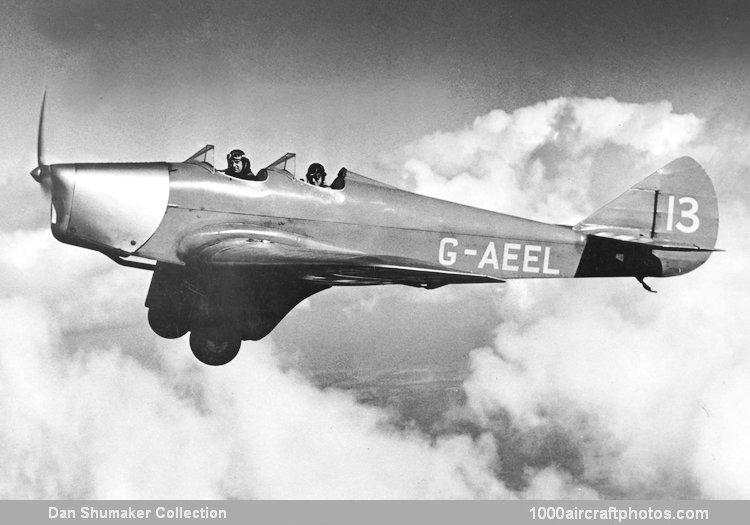
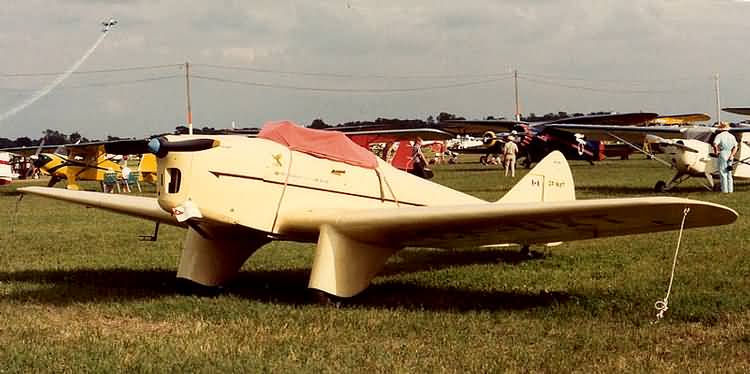
07/20/2026. Remarks by Johan Visschedijk: "The Hawk two seat, low-wing, cantilever monoplane was designed in 1933 by F.G. Miles, and although a structurally orthodox light aircraft with plywood covered two spar wing and box-built fuselage, excited comment in the heyday of the biplane because its cantilever wing was also designed to fold. Powered by a 95 hp ADC Cirrus IIIA, the prototype, G-ACGH (c/n 1), was built in the workshops of Phillips and Powis Ltd. at Woodley airfield, Reading, England. In fact, all Miles designs up to the M.38 Messenger were built by Phillips and Powis Ltd., in October 1943 the name changed to Miles Aircraft Ltd. Piloted by its designer, G-ACGH made its first flight on March 29, 1933, and proved so viceless that 53 pilots, mainly inexperienced, flew it within a week, the number rising to over eighty by the end of April.
Right from the initial test flight it was obvious that the M.2 Hawk was a really good aircraft, and features of its design are traceable throughout the earlier Miles machines, particularly in the Magister trainer, which was its ultimate development. Before going out of production the original Hawk design, of which considerable numbers were built, appeared in at least 22 different versions, some of which were to purchasers' specifications, while others were normal design developments. The main variations included five different types of power unit, with a three-seat model for joy riding, special aerobatic and racing versions and, of course, the incorporation of the Miles split trailing-edge flaps, which occurred quite early in the series. Of these developments the most outstanding was the Hawk Trainer.
An improved version of the M.2H Hawk Major was built late in 1935 to supplement the Tiger Moths) then in use at Woodley airfield with RAF No. 8 ERFTS (Elementary and Reserve Flying Training School), which was operated by Phillips & Powis Ltd.