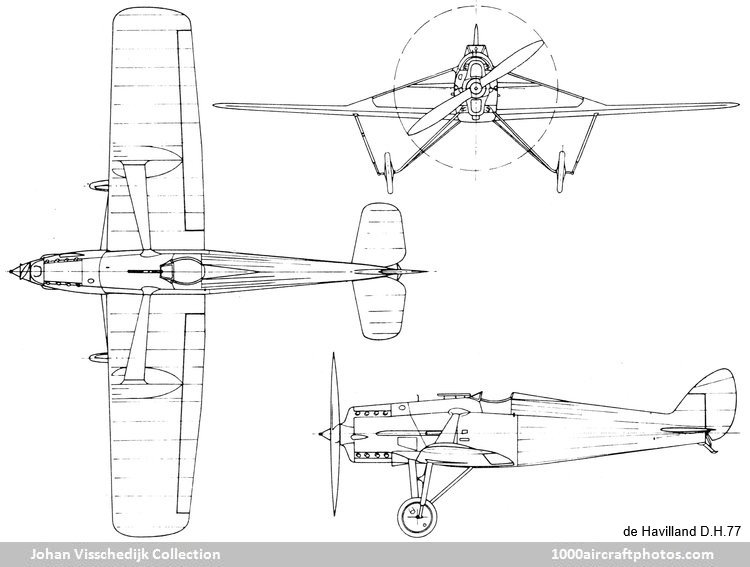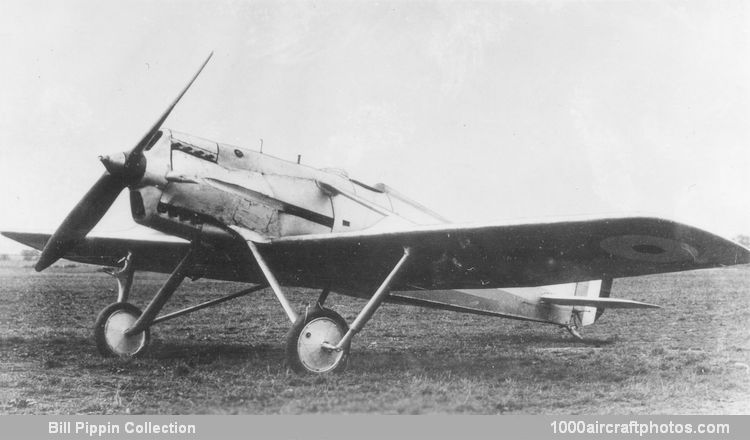
de Havilland submitted their D.H.77 as a private venture, powered by a new experimental 300 hp Napier Halford 'H' engine. This air-cooled engine had two parallel crankshafts with four banks of four cylinders; later it was named Napier Rapier I. The low monoplane wing was braced with streamlined tubular struts, the undercarriage was fixed, and the pilot sat in a high placed open cockpit. Composite construction was used with steel tube in the fuselage and fabric over wood fairings. The wings consisted of a single spruce main spar with three-ply skin.
Serialed J9771,the D.H.77 was first flown at Stag Lane Aerodrome, Edgware, England by H.S. Broad on July 11, 1929. In its official trials by the A&AEE at Martlesham Heath, near Ipswich, England, the D.H.77 performed generally very well proving the greater efficiency of the monoplane layout, and achieving equivalent results to the biplane Hawker Fury using only 60% of the power. The main criticism was of the ailerons, which were heavy and ineffective close to the stall, but the aircraft missed the main competitive trials due to teething troubles with the new engine. The D.H.77 was also unsatisfactory in a spin. No doubt all the problems could easily have been cured, but the Fury biplane had already been chosen.
On completion of the official trials, the D.H.77 became the third and last military aircraft to be transferred to Glosters, where the armament was removed and it was flown on engine development until going to Farnborough in December 1932 for further engine testing. While at Farnborough, a 295 hp Rapier II was installed and a crash guard was fitted over the cockpit. In this form the sole D.H.77 continued flying at the RAE on engine and spinning trials until disposal in June 1934."
Span: 32 ft 2 in (9.80 m)
Length: 24 ft 4.75 in (7.44 m)
Height: 7 ft 6 in (2.29 m)
Wing area: 163 sq.ft (15.14 sq.m)
Empty weight: 1,655 lb (751 kg)
Max take off weight: 2,285 lb (1,036 kg)
Max speed: 204 mph (328 kmh)
Service ceiling: 24,000 ft (7,315 m)