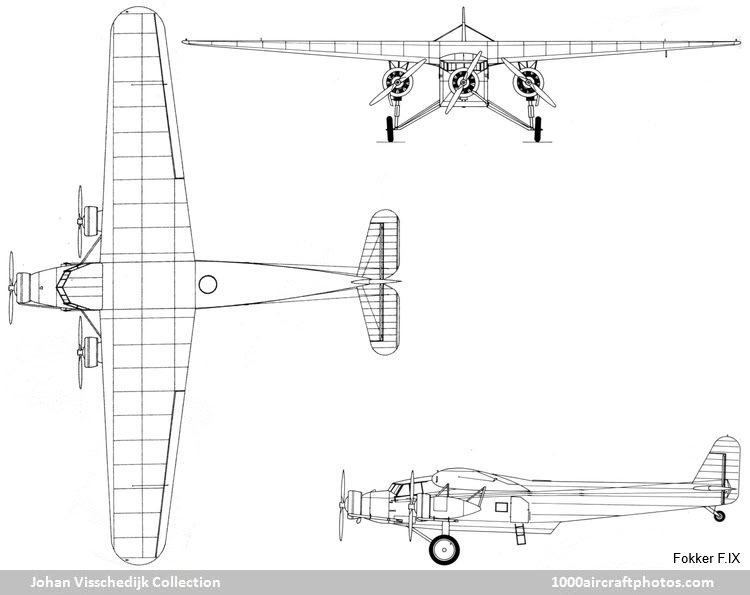
The prototype F.IX, PH-AGA (c/n 5106), made its first flight on August 26, 1929, was delivered to KLM on May 8, 1930, and named Adelaar (Eagle). In layout and structure the F.IX was generally similar to the earlier types, and in its original form could carry eighteen passengers on European services or four to six passengers on the Far East route. The engines were 480/500 hp Gnome & Rhône Jupiter VI nine-cylinder air-cooled radials.
On November 13, 1930, the F.IX left Amsterdam on its first flight to Batavia. It carried 458 lb (208 kg) of mail and 26 lb (12 kg) of cargo as well as equipment to test short- and long-wave radio reception and trans-mission along the route. The outward journey took thirteen days and involved 84 hr 20 min flying, and the return flight twelve days with 84 hr flying; nevertheless, the F.IX never went into regular service on the route.
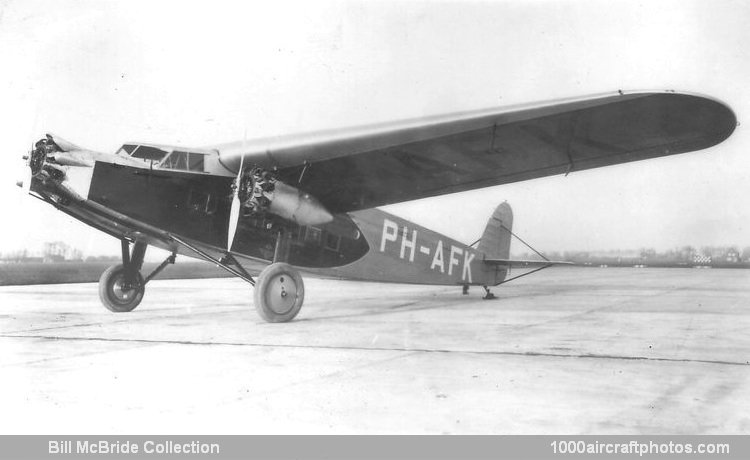
In 1930 Fokker built a second F.IX, also with Jupiters, for the Far East route. This was PH-AFK (c/n 5241), which had a lengthened nose, modified cockpit and larger passenger cabin with accommodation for up to 20 passengers. PH-AFK was exhibited at the 1930 Paris Salon, where it was awarded the Grand Prix de Confort et d'Élégance d'Avions de Transport (Grand Prix for Comfort and Elegance of Transport Aircraft). This F.IX was delivered.to KLM on January 15, 1931, but on August 4 the same year was written off in a crash at Waalhaven airport, Rotterdam, the Netherlands.
PH-AGA continued in service with KLM until the autumn of 1936. It was fitted with seventeen passenger seats, and used mainly on the Amsterdam-London route. For a short period in 1934-1935 it was fitted with one 650 hp Wright Cyclone nine-cylinder air-cooled radial engine and two 575 hp Pratt & Whitney Hornet nine-cylinder air-cooled radials, but in 1935 was re-engined with three 650 hp P&W Hornet T1C1s, and it is believed that it had been lengthened to conform to the standard of the second aircraft. In October 1936 PH-AGA was sold to Sté Française de Transports Aériens (Air Tropic) as F-APFA and most likely went to Spain.
In Czechoslovakia Avia built under license a bomber variant of the Fokker F.IX, these were designated Avia F.39 by the Czechoslovakian AF. The F.39 was significantly modified, most had one- or two-gun turrets under the fuselage; a person could sit in the forward turret to operate the guns. Of the approximately eighteen F.39 aircraft built, a number were supplied to the Yugoslav army, and at least two F.39s ended up with the German Luftwaffe years later.
A commercial version was also produced by Avia, this was also known as the F.39, but more generally as the F.IXD. The F.IXD was generally similar to the Dutch F.IX, and was of typical Fokker construction with all-wood wing and fabric-covered welded steel-tube fuselage. The enclosed cockpit had two seats and there was accommodation for twenty passengers. In the summer of 1935, two F.IXD aircraft were delivered to ČSA (Československé Státní Aerolinie, Czechoslovak State Airlines), registered OK-AFF and OK-AFG.
The Czechoslovak aircraft were powered by three 580 hp Walter Pegasus II.M2 nine-cylinder air-cooled radial engines which drove three-blade metal airscrews."