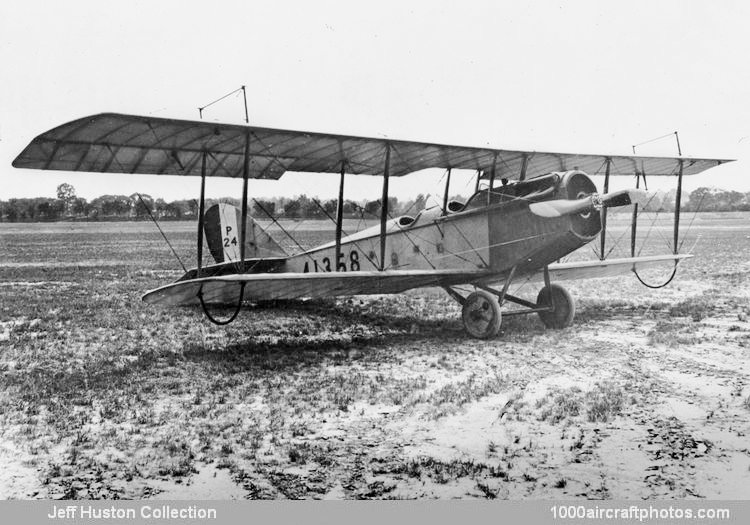
07/20/2026. Remarks by Johan Visschedijk: "Curtiss wanted an improvement of the JN-4H that would have sufficient speed and maneuverability to serve as a truly advanced trainer, to be designated JN-5H. From a batch of 400 JN-4Hs (37933 to 38332) under construction for the USASC, s/n 38124 was taken from the Curtiss production line for conversion to the JN-5H. Since this model was the subject of a separate contract, it was given the new serial number 41358.
The JN-5H had equal-span wings shortened to 30 ft (9.14 m) and a revised vertical tail shape. Two sets of wings, one with the RAF 15 airfoil and one with the Eiffel 36 airfoil, were supplied. The almost triangular shape of the JN-4 tail was replaced with one with a semi-circular training edge and a small section jutting forward of the hinge to help balance it.
Delivered to the Army in March 1918, inadvertently still carrying the JN-4H serial 38124, the JN-5H was beaten by the Lewis-Vought VE-7 in the fly-off to win the advanced trainer contract.
In June 1918, the JN-5H was reconverted and redesignated JN-4H, but was given the serial 41358. It served at McCook Field as a test bed under the McCook Project Number "P-24", and was fitted with an early controllable-pitch propeller and an experimental rudder that incorporates a steerable tailskid. At one time it was fitted with an experimental set of steel-frame wings (still with the JN-5 rudder) and later the 150 hp Wright-Martin A was replaced by an 180 hp Wright-Martin E engine and fitted with a JN-4H rudder.
Flown by a Captain Fleet, the aircraft was wrecked near Shelby, Ohio, on August 18, 1920."